Retrieval-augmented generation
Build a retrieval-augmented generation (RAG) workflow that searches documents and gives the matching passages to a model. Run the end-to-end example with Ollama or OpenAI, or explore each stage below.
document(github.com/masterkeysrd/loom/document) —Document, lazy iteratorLoaderimplementations, and textSplitterchunkers (RecursiveCharacterSplitter,MarkdownSplitter).vectorstore(github.com/masterkeysrd/loom/vectorstore) —VectorStoreinterface and backends (memory,sqlite,pg) for batch embedding, similarity search, and metadata filtering.retriever(github.com/masterkeysrd/loom/retriever) —Retrieverruntime interface with OpenTelemetry spans,on_retrievestream events, Reciprocal Rank Fusion (NewMerger), System One decision reranking (NewDecisionReranker), and agent tool integration (NewTool).
Indexing and retrieval use the same vector store.
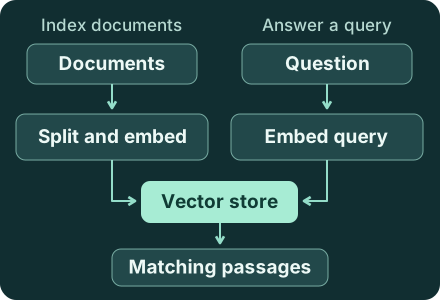
| Stage | Input | Result |
|---|---|---|
| Index documents | A loader streams documents to a splitter. | The splitter yields chunks to embed and store. |
| Retrieve passages | A retriever receives a query and searches the store with a result limit and optional filters. | The retriever returns matching documents to a graph node or agent tool. |
1. Loading Documents (document.Loader)
Every loader in document implements a single-method lazy iterator interface using Go’s iter.Seq2[Document, error]:
type Loader interface { Load(ctx context.Context) iter.Seq2[Document, error]}Built-in Loaders
| Loader | Constructor | Description |
|---|---|---|
TextLoader |
document.NewTextLoader(text, meta...) |
Wraps an in-memory string as a Document. |
ReaderLoader |
document.NewReaderLoader(r, source, meta...) |
Reads any io.Reader into a single Document. |
FSLoader |
document.NewFSLoader(fsys, patterns...) |
Lazily walks an fs.FS (e.g. os.DirFS, embed.FS) matching glob patterns and populates source, path, name, ext metadata. |
CSVLoader |
document.NewCSVLoader(r, opts...) |
Streams CSV rows lazily (WithCSVSource, WithCSVContentColumns, WithCSVDelimiter). |
JSONLoader |
document.NewJSONLoader(r, opts...) |
Streams JSON arrays, objects, or JSONL (WithJSONLines(true), WithJSONContentKey). |
HTMLLoader |
document.NewHTMLLoader(r, opts...) |
Parses HTML DOM via golang.org/x/net/html, extracts <title> and <meta name="description">, and strips <script>/<style>/boilerplate tags. |
import (    "context"    "os"
    "github.com/masterkeysrd/loom/document")
ctx := context.Background()
// Lazily walk all Markdown files in ./docsloader := document.NewFSLoader(os.DirFS("./docs"), "*.md")
// Materialize into a slice when needed:docs, err := document.LoadAll(ctx, loader)
2. Splitting Documents (document.Splitter)
Large documents should be split into smaller, overlapping chunks before embedding so that retrieved passages stay focused and fit comfortably in the model’s context window.
Recursive Character Splitter
Splits text hierarchically by ["\n\n", "\n", " ", ""] to keep paragraphs and sentences intact:
splitter := document.NewRecursiveCharacterSplitter(    document.WithChunkSize(1000),    document.WithChunkOverlap(200),)
chunks := splitter.SplitDocuments(docs)
Markdown Splitter
Splits Markdown by headings (#–######), records active section headings in each chunk’s Metadata ("h1", "h2", etc.), and keeps fenced code blocks intact:
mdSplitter := document.NewMarkdownSplitter(    document.WithChunkSize(800),    document.WithChunkOverlap(100),)
// Stream lazily from Loader -> Splitter without loading all files into memory at once:for chunk, err := range document.SplitIter(loader.Load(ctx), mdSplitter) {    if err != nil {        log.Fatal(err)    }    // chunk.Metadata["h1"], chunk.Metadata["chunk_index"], chunk.Metadata["parent_id"]}
3. Indexing & Searching (vectorstore.VectorStore)
vectorstore.VectorStore embeds batches of documents via embedding.Model.EmbedDocuments and searches them by cosine similarity.
Choosing a Backend
In-Memory
import (    "github.com/masterkeysrd/loom/vectorstore/memory")
vs := memory.New(embedModel)
SQLite
import (    "database/sql"    "github.com/masterkeysrd/loom/vectorstore/sqlite"    _ "modernc.org/sqlite")
db, _ := sql.Open("sqlite", "vectors.db")vs, err := sqlite.New(db, embedModel)
PostgreSQL pgvector
import (    "database/sql"    _ "github.com/lib/pq"    "github.com/masterkeysrd/loom/vectorstore/pg")
db, _ := sql.Open("postgres", os.Getenv("POSTGRES_DSN"))vs, err := pg.New(db, embedModel, pg.WithDims(1536))
Adding, Searching, and Deleting Documents
// 1. Batch-embed and index chunksids, err := vs.Add(ctx, chunks, vectorstore.WithAddNamespace("docs"))
// 2. Similarity search with metadata filter, minimum score, and optional MMR diversificationmatches, err := vs.Search(ctx, "How do I resume an interrupted graph?", 5,    vectorstore.WithNamespace("docs"),    vectorstore.WithFilter(map[string]any{"ext": ".md"}),    vectorstore.WithMinScore(0.55),    vectorstore.WithMMR(0.5, 20), // Balance relevance (0.5) and diversity across top 20 candidates)
// 3. Delete by ID_ = vs.Delete(ctx, ids, vectorstore.WithDeleteNamespace("docs"))
4. Composable Retrievers (retriever.Retriever)
The retriever package provides a uniform query interface (Retrieve(ctx, query, opts...) ([]document.Document, error)) with built-in OpenTelemetry tracing and on_retrieve stream events.
Vector Store Retriever
import "github.com/masterkeysrd/loom/retriever"
baseRetriever := retriever.FromVectorStore(vs,    retriever.WithNamespace("docs"),    retriever.WithTopK(10),    retriever.WithMMR(0.6, 30),)
BM25 Lexical Retriever & Reciprocal Rank Fusion (NewBM25 + NewMerger)
Pair BM25Retriever (Okapi BM25 keyword search) with VectorStoreRetriever inside NewMerger for hybrid lexical + semantic search:
bm25Retriever := retriever.NewBM25(chunks)
mergedRetriever := retriever.NewMerger(    []retriever.Retriever{baseRetriever, bm25Retriever},    retriever.WithRRFConstant(60),)
System One Decision Reranker (NewDecisionReranker)
Use a fast decision.Model to evaluate each candidate chunk in parallel, discard irrelevant passages below a probability threshold, and sort by calibrated relevance probability:
reranker := retriever.NewDecisionReranker(    baseRetriever,    decisionModel,    "Does this document contain factual information that helps answer the query?",    retriever.WithThreshold(0.65),)
topDocs, err := reranker.Retrieve(ctx, "How does SQLite checkpointing work?", retriever.WithTopK(3))
Agent Tool Integration (NewTool)
Expose any Retriever directly to an LLM agent as a read-only tool.Tool:
kbTool, err := retriever.NewTool(    "search_knowledge_base",    "Search internal documentation for architecture and API usage guides",    reranker,    retriever.WithTopK(4),)
container := tool.NewContainer(kbTool)chatModel = chatModel.BindToolDefs(container.Definitions()...)
5. End-to-End Example (examples/rag)
Loom includes a complete, runnable end-to-end RAG example in examples/rag/main.go. It demonstrates:
- Streaming documents lazily with
document.NewFSLoader. - Chunking Markdown by heading hierarchy with
document.NewMarkdownSplitter. - In-memory vector store indexing (
vectorstore/memory) with dense embeddings. - Hybrid lexical (BM25) and semantic retrieval with Reciprocal Rank Fusion (
retriever.NewMerger). - A stateful RAG graph workflow (
retrieve→generate) usinggraph.Builder.
Running with Ollama (Local)
Ensure Ollama is running and has the required models installed (ollama pull gemma3 and ollama pull nomic-embed-text):
go run ./examples/rag -provider ollamaYou can customize the query and models using CLI flags:
go run ./examples/rag -provider ollama -llm-model gemma3 -embed-model nomic-embed-text -query "How does Loom checkpoint graph state?"Running with OpenAI
export OPENAI_API_KEY="sk-..."go run ./examples/rag -provider openai -query "How do decision models route graph workflows?"